
October Revolution, Petrograd, 1917
Participant: 17-year-old palace footman, servant within the Romanov household
I had been taught that silence was part of service.
Not merely the silence of speech, but of presence. To walk without sound across polished parquet. To refill crystal without interrupting conversation. To stand beside gilded doors like a shadow in livery while ministers, duchesses, and officers moved beneath chandeliers heavy as captured suns.
By seventeen, I knew the Winter Palace better than I knew my own mother’s face. I knew which corridor carried draughts from the Neva, which doors swelled in winter damp, which Romanov preferred tea stronger, which officer drank before noon. I knew where the wax dripped fastest beneath the candelabras and how gold could dull when Petrograd coal ran thin.
Outside, Russia was starving.
Inside, the mirrors were still polished.
That was perhaps the strangest part. Even as bread lines stretched like funeral processions through the capital, even as soldiers muttered and disappeared, even as rumours arrived faster than wagons, the palace maintained its rituals. Silver was laid. Uniforms were brushed. Shoes shined. Titles spoken correctly.
The old world, I learned, rarely collapses all at once. First, it performs itself harder.
By October, whispers travelled downstairs faster than orders upstairs.
The kitchen girls spoke of Bolsheviks. The laundresses spoke of workers with rifles. A wounded officer, pale and shaking near the servants’ stairwell, muttered that the Provisional Government was finished. Some said Lenin was a German agent. Others said he was Russia’s future. I did not know. I only knew that men who once barked commands now spoke with the softness of frightened children.
That evening, the palace felt less like a fortress than a theatre waiting for its final act.
The halls were magnificent as ever — endless white columns, imperial portraits, ceilings painted with gods who had never known hunger — but beneath the splendour was something new:
hesitation.
I was carrying a tray of glasses near the Malachite Room when I first heard it clearly.
Not conversation.
Not music.
Gunfire.
Distant at first. Then nearer. Sharp cracks against the freezing air, like the snapping of old bones.
No one announced that history had arrived. There was no grand declaration. Only confusion.
Doors opened too quickly. Boots struck marble floors. A lady cried somewhere. One minister demanded updates no one could give. Another asked for transport. Somewhere below, servants crossed themselves.
I remember looking at a mirror — one I had polished that morning — and seeing my own face, pale beneath candlelight, surrounded by imperial excess.
For the first time, I understood that a palace could be both enormous and defenceless.
Then came the noise.
Shouting. Running. The unmistakable rupture of barriers breached not by foreign invaders, but by Russians.
Russians storming Russia.
Red Guards flooded inward not like disciplined ceremony, but like history uninvited. Wet boots, harsh breath, worker’s coats, rifles clutched by hands that had known factories more than ballrooms. Some looked furious. Some looked awed. Some, strangely, looked as uncertain as I felt.
I pressed myself behind a carved doorway, still in servant’s uniform, invisible as I had been trained to be.
A boy no older than twenty, rifle shaking in his grip, stared up at a chandelier.
“Look at this,” he whispered.
Not with hatred.
With disbelief.
And in that moment, I realised this was not merely conquest.
It was collision.
Two Russias meeting beneath crystal.
One built on bloodline, French, gold leaf, and divine inheritance.
The other on soot, queues, ideology, and hunger.
I do not know precisely when the old Russia died. Historians may argue whether it was the abdication, the war, the storming, or the cellar in Ekaterinburg yet to come.
But I know when I felt it.
It was when no one bowed anymore.
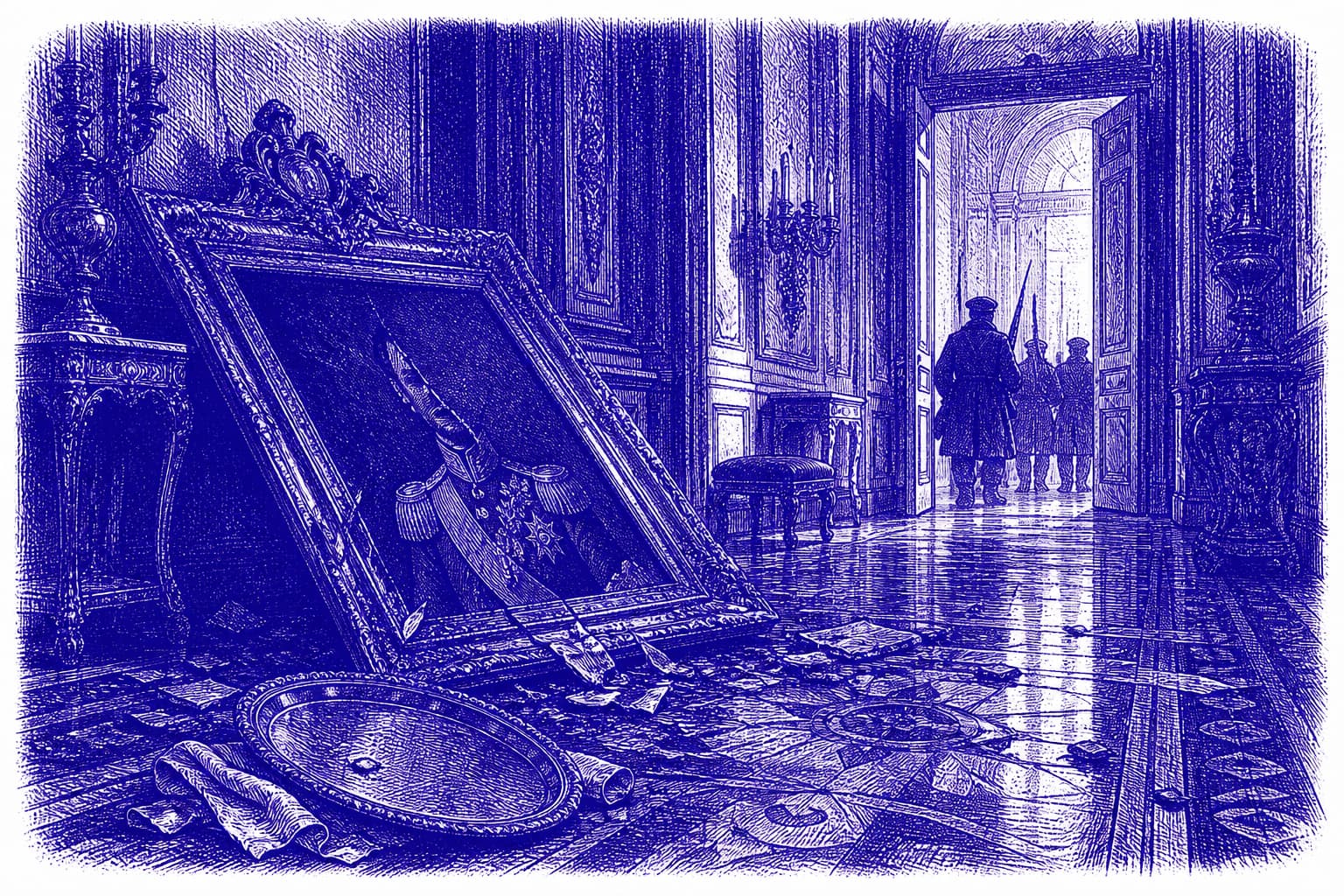
Somewhere in the chaos, a portrait fell.
I cannot remember whether it was Peter, Catherine, or Nicholas. Only that the frame cracked loudly enough to silence the corridor for one impossible second.
And then the shouting resumed.
By dawn, the palace still stood.
Its walls had not vanished. Its chandeliers still glittered. Its carpets still softened footsteps.
But something far larger than stone had been taken.
Belief.
I left service soon after. Not from bravery. Not from ideology. Simply because the world I had been trained for no longer existed.
I had entered the palace as a servant of empire.
I left it as witness to its evaporation.
People speak of revolutions as thunderclaps, but from inside, they feel more like a great door quietly unlocking after centuries — and then suddenly slamming open.
I once believed power lived in crowns, uniforms, and gold.
But on that freezing Petrograd night, I learned something colder:
Power lives where enough people decide the performance is over.